
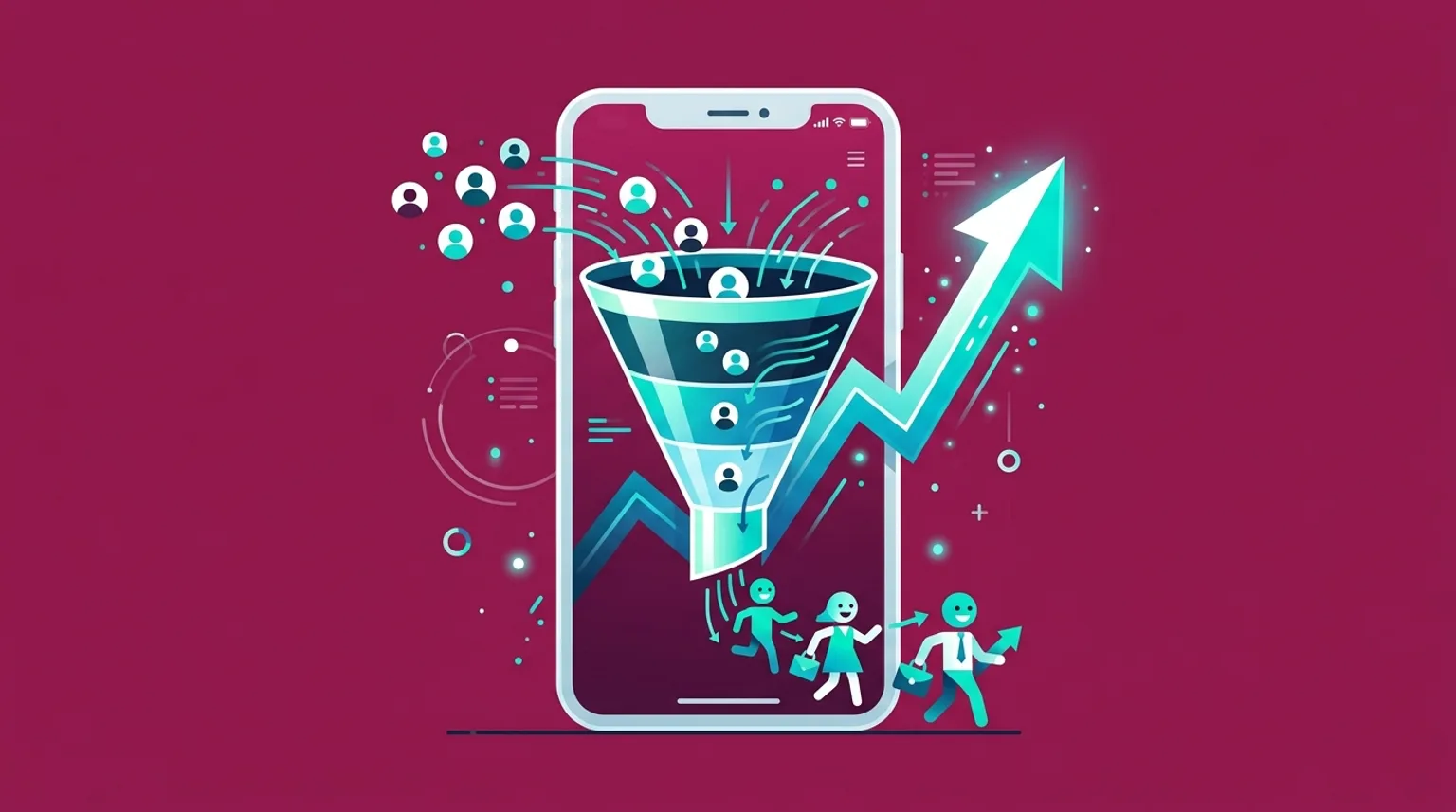
How Good UX Boosts Your App or Website Conversion
Learn how UX Design directly influences your digital product's conversion rate and which improvements bring more customers from the same traffic.
Most companies invest heavily to attract visitors — ads, SEO, social media — but lose a large share of them at the decisive moment: the experience inside the app or website. That's where UX Design comes in. When the experience is good, more visitors become customers without increasing your traffic spend. In this post, we explain how that works in practice.
Why UX Impacts Conversion
Conversion is the percentage of people who take the action you want: buy, sign up, request a quote, or subscribe. Every obstacle along the way — a confusing form, a hidden button, a slow page — makes a portion of visitors give up.
UX Design works precisely to remove that friction. Instead of spending more to bring in new people, you make better use of those who already arrived. It's the cheapest way to grow: improving the conversion rate of the traffic you already pay for.
What Usually Hurts Conversion
In practice, the biggest conversion killers are almost always experience problems:
- Too many steps — long forms and checkouts with many stages;
- Lack of clarity — the user doesn't understand what to do or what comes next;
- Weak trust — no social proof, security signals, or contact information;
- Slowness — pages that take too long to load drive users away before the content even appears;
- Poor mobile experience — most traffic is mobile, yet many sites still don't prioritize it.
How UX Increases Conversion in Practice
Good UX work attacks these points with decisions based on real behavior:
- Simplifies the journey — fewer clicks and fewer fields to convert;
- Guides the eye — visual hierarchy and clear CTAs that show the path;
- Reduces friction — autofill, instant feedback, and helpful error messages;
- Builds trust — testimonials, badges, and clear information at the right moment;
- Optimizes for mobile — an experience designed mobile-first.
Small changes in these areas often produce significant conversion gains — frequently larger than doubling your ad budget.
How to Measure the Impact
UX isn't guesswork: it's data-driven improvement. The main ways to measure it are:
- Conversion rate per step — where people drop out of the funnel;
- A/B testing — comparing two versions and validating what converts more;
- Heatmaps and session recordings — seeing where users click, scroll, and get stuck;
- Usability testing — watching real people use the product.
With this data, every design improvement can be tied to a business result.
How to Get Started
You don't need to redesign everything at once. The most efficient path is to identify the points of greatest friction and optimize those first — usually the checkout, the sign-up, or the lead-capture page.
At QuickLab, we treat UX as part of development: we analyze the journey, design the best experience, and deliver interfaces ready to convert — always focused on business results.
Want to increase your product's conversion? Talk to our team and get a tailored assessment, with no commitment.
See how QuickLab can help your business: UX UI Design

Ready to bring your digital project to life?
Talk to QuickLab and get a tailored proposal for your project.
