

4 first steps to developing a mobile app
The software used by billions of people around the world offers countless features to its users and is increasingly present in our daily lives.
The software used by billions of people around the world offers countless features to its users and is increasingly present in our daily lives. Called apps, what sets them apart from other programs is the platform used: smartphones, tablets, smartwatches, and smart TVs.
All this growth has opened the door to a thriving market with many opportunities, given the wide variety available in apps and their increasingly frequent use. If you or your company are thinking about or working on creating a new application, this post is for you!
Check out the 4 first steps to developing a mobile app.
1. Defining goals
The first tip on our list is also the most important and will be responsible for the entire structure of the new app. The first step in any new app project is defining the solution it will offer—that is, what problem will the app solve?
After this definition, it is important to study the market and your future competition. This will provide valuable insights into the field. Also analyze the strengths and weaknesses of your future competitors. This will be essential to creating your market differentiator.
Once that is done, it is time to define your target audience. Analyze and gather information about the audience and the market through field research. These will be the references needed to build your product's persona.
2. Defining the strategy
With all the inputs collected, you will be able to define the best strategy to use for your new app. Some of the questions that should be analyzed and answered:
- Which platform will be used (Android, iOS, etc.)
- Type of app
-
- Native
Developed for specific platforms, adopting a programming language predefined by the manufacturer - Web app
Responsive site for mobile devices - Hybrid
Developed for Android and iOS, using a single source code through some framework
- Native
- Identifying key resources (team, equipment, etc.)
- Mapping out the necessary investment costs
- Monetization methods (ads, paid download, freemium, subscription, etc.)
3. Planning the features
With the problem defined, it is time to work on the solution. Several features—direct and indirect—will be needed to address this problem. Check out some examples:
- Registration
- Geolocation
- Payment
- History
- Chat
This mapping will serve as the basis for developers to define all the technologies needed to implement the app.
4. Production
Design/Storytelling With the type of app defined, it is time to start creating. All the information collected so far made it possible to create your business plan. Now you can begin building your service by sketching out your app. These sketches will illustrate all the features and functional flows of your app.
To do this, organize all your ideas and put them on paper, structuring all the steps and paths available to your user—that is, your storytelling.
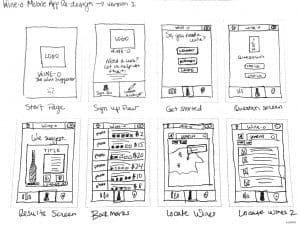
It is essential that navigation be fluid and intuitive. But remember that this is just a sketch, which will serve as a guide for the final design.
5. Development
We have reached the most technical part of the project: its development. At this stage, there are two options: develop it yourself or hire a company specialized in the subject. In either case, the following tools will be needed to create the apps:
- IDE (Integrated Development Environment)
- SDK (Software Development Kit)
Frameworks - Database
- Servers
They will be essential for the:
- Back-end:
uses programming languages to create the code responsible for the app's features and its connection to the database and users
- Front-end:
uses languages such as HTML, CSS, and JavaScript to develop the app's graphical interface
The code must be hosted on servers, with the most widely used today being Google Cloud and Amazon's AWS.
With the coding defined, do not forget to test the product before releasing it to the public. You need to look for bugs in the code and analyze the experience provided throughout the app's entire flow. Remember that you must pay attention both to the technical part and to the usability of the service. One tip is to bring in outside people to run the tests, seeking feedback and opinions that can lead to improvements in the final product.
Those were the tips here from QuickLab! If you need more information, send us a message. We have a team of development specialists ready to help you.
See how QuickLab can help your business: Développement d'Applications


Ready to bring your digital project to life?
Talk to QuickLab and get a tailored proposal for your project.
