
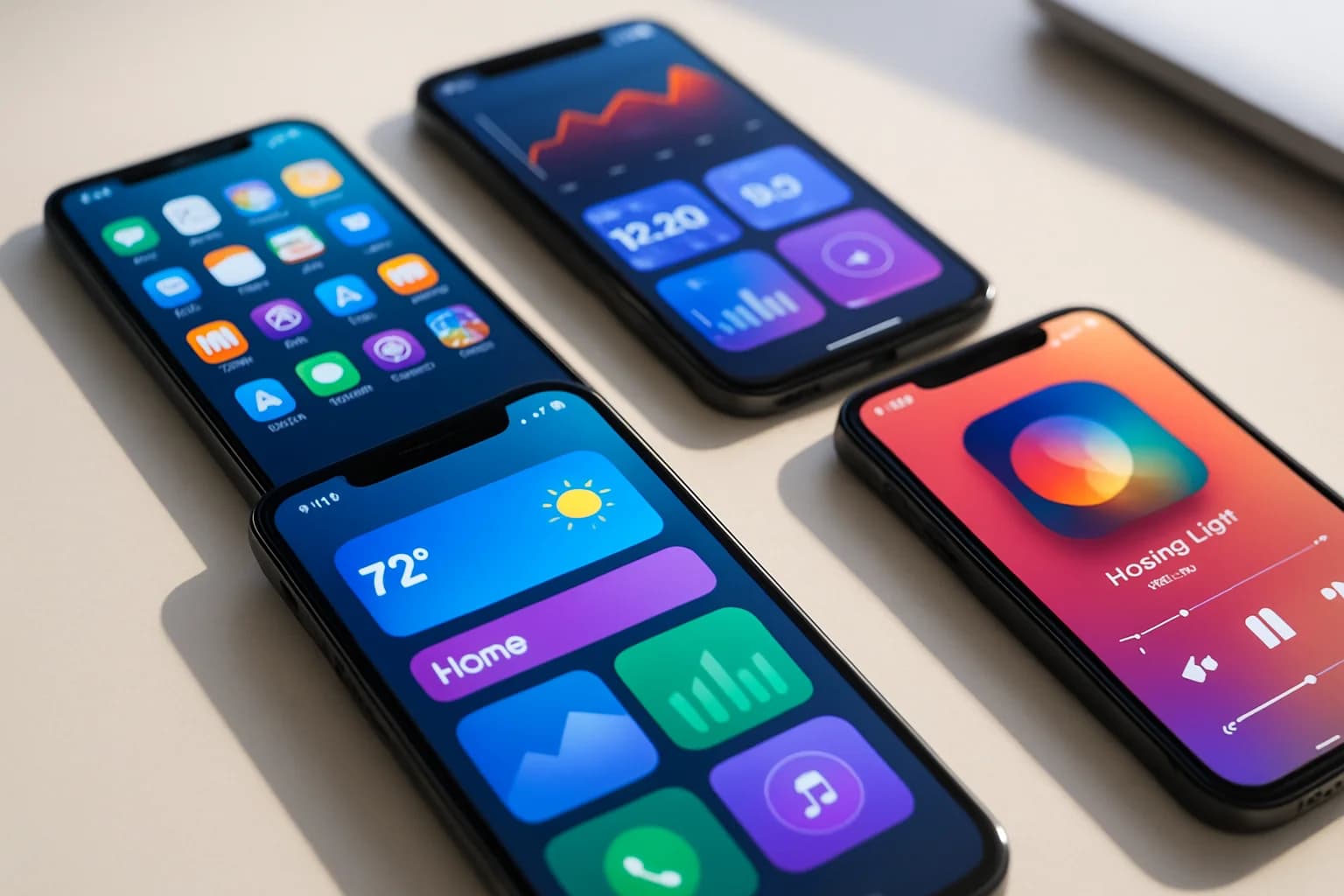
5 trends for mobile apps in 2026
The market for mobile app development continues to expand, and new technologies promise to transform the mobile experience in 2026.
The market for mobile app development continues to follow the growth trend of recent years, expanding its indicators year after year. We have prepared a list of 5 technologies that are expected to be trends in 2026 in the world of mobile apps.

Generative AI is no longer a novelty and has become a central component of modern apps. In 2026, it is estimated that more than 70% of successful apps will use some embedded AI feature, with operating systems like Android and iOS offering increasingly deep native integration with generative assistants.
In practice, this enables real-time personalization, task automation, content generation and predictive analysis directly on the device — making the experience smarter, more contextual and faster for the user.
With the expansion of 5G, latency decreases drastically and speed increases, opening the way for advanced real-time experiences. High-quality streaming, cloud gaming, uninterrupted video calls and applications that depend on instant processing become viable anywhere.
For the development sector, 5G represents the possibility of creating more robust and connected apps, which were previously limited by network infrastructure.
The combination of affordable smartphones, 5G connectivity and embedded artificial intelligence creates the ideal environment for so-called super apps — unified platforms that concentrate various services (payments, messaging, shopping, transportation and much more) in a single app.
This convergence reduces the fragmentation of the mobile experience and opens new business opportunities for companies that can integrate multiple services seamlessly.
Immersive technologies, such as Augmented Reality (AR) and Virtual Reality (VR), are no longer niche and are increasingly present in sectors such as retail (trying on clothes and furniture virtually), education (training and interactive classes) and entertainment (games and immersive experiences).
With the advancement of smartphone hardware, this type of feature becomes accessible to a much larger audience, expanding the possibilities for app developers.
Cross-platform frameworks like Flutter and React Native allow you to use a single code base for iOS and Android, reducing costs and development time by up to 40% compared to dual native development.
In addition, low-code and no-code platforms continue to democratize app creation, allowing companies to validate ideas and launch products with greater agility. In 2026, this approach is increasingly common for both MVPs and enterprise solutions.
This was QuickLab's list of the 5 main trends for the world of mobile apps in 2026, a year that promises to accelerate digital transformation even further.
See how QuickLab can help your business: Développement d'Applications


Ready to bring your digital project to life?
Talk to QuickLab and get a tailored proposal for your project.
